Your individuality is important, but so is belonging. Recognize the parts of your culture that have shaped your past, and the parts you want to carry with you into the future. - Sol Peralta
Honoring your roots, wherever they come from, can be difficult as you grow up and establish your own household. Life may take you far away from the ones who raised you, taught you your native tongue, and showed you how to navigate the kitchen. But no matter where you are, your culture and traditions follow you.
They find you in the grocery store when you’re picking out which spices to get, or in the kitchen when you find three ways to use one ingredient. It might be in the music you listen to or the way you take care of guests in your home. For 65 million Americans, their identity is rooted in Hispanic culture. And from September 15th - October 15th, Hispanic Heritage Month celebrates the influence, history and achievements of Hispanic Americans.
As the largest minority group in the nation, Hispanic culture influences many areas of American life. Whether it's food or music,business or politics, Hispanics have had their hand in cultivating diverse traditions across the country.
However, as the Hispanic population continues to grow, so does hunger within the community. Of the 47 million Americans facing hunger, 14 million identify as Hispanic or Latino. From language barriers to the high cost of food, minority groups continue to face hunger at a higher rate than non-minorities. Communities located in food deserts and other obstacles such as transportation often get in between hunger and food. Even additional resources such as food banks or SNAP aren’t utilized because these communities don’t know that they are available to them.
While this minority group experiences hunger at an alarming rate, Hispanics are also responsible for the majority of produce we eat in the U.S.
Did you know 78% of agricultural farm workers in the U.S. identify as Latino/Hispanic? Yet 1 in 4 Hispanics experienced food insecurity at some point in the last year.
In World War II, when many working-age American soldiers went to fight overseas, farmers from Mexico came to help supplement agricultural labor shortages. They were responsible for harvesting the crops most Americans depended on to eat. Since then, Hispanics farmworkers have contributed to crop diversity, workforce participation, and overall output.
For many Hispanics, food is a pivotal part of cultural identity and expression that unifies family and communities. One thing that always reigns true within this community is the value and sanctity of food. That’s a piece that’s culturally absent in much of the U.S. We see food in abundance. Though grocery stores may be far and few between, there are plenty of drive-thru, fast-casual and other dining experiences available at any time.
In the U.S., restaurants alone waste over 11 million tons of food every year. American chains often offer a vast variety of complex dishes, which causes a lot of waste to happen. This then plays a vital role in why the U.S. is responsible for more than one-third of all global food waste, while Latin countries only make up about 6% of losses. There is definitely a page we can take from the book of other cultures - food is precious.
There’s a “no waste” mentality which is why recipes often call for whole ingredients to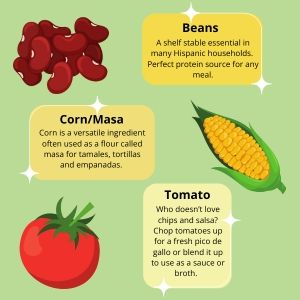
Ingredients such as corn or masa, are used to make a variety of dishes such as tortillas, tamales, and empanadas. Tomatoes are blended for sauces, chopped for pico de gallo, and topped on tacos. Keeping shelf stable foods around like rice and beans is also an essential part to any Hispanics lifestyle. These are two ingredients that are affordable, can be added to any meal, and can serve as a main protein source in times when food is scarce.
For example many countries have their own version of a dish called Picadillo. In general this what the recipe calls for:
▢1 lb of ground beef
▢ A whole yellow onion
▢ Garlic
▢ 5 Tomatoes
▢ Beef Broth
▢ Olives
▢ Potatoes
▢ Carrots
▢ Peas
Measure with your heart and use whatever is on the brink of spoiling in the fridge. Making versatile recipes with what you typically keep on hand is a great way to reduce your food waste.
Because of this zero waste mindset, Hispanics have long contributed to reducing food waste by using preservation techniques such as fermentation, pickling, and drying.
Specifically in Mexican cuisine, fermentation is used to make colonche, pozol, and tepache. In other cultures pickling is used to make appetizers or curtidos along with chupadedos, banderillas, and escabeche.
Each country has something unique and delicious to offer, but all have one thing in common. Food is an integral part of Hispanic culture. It’s the glue that holds traditions, community, and culture together. In any Hispanic household the kitchen is truly the heart of the home.
The Hispanic community plays an important role in food recoveries and redistribution efforts across the country. They are at the forefront of sustaining community fridges, gardens, and food banks. This month we celebrate this vibrant community, their historical impact, and ongoing influence on American culture.